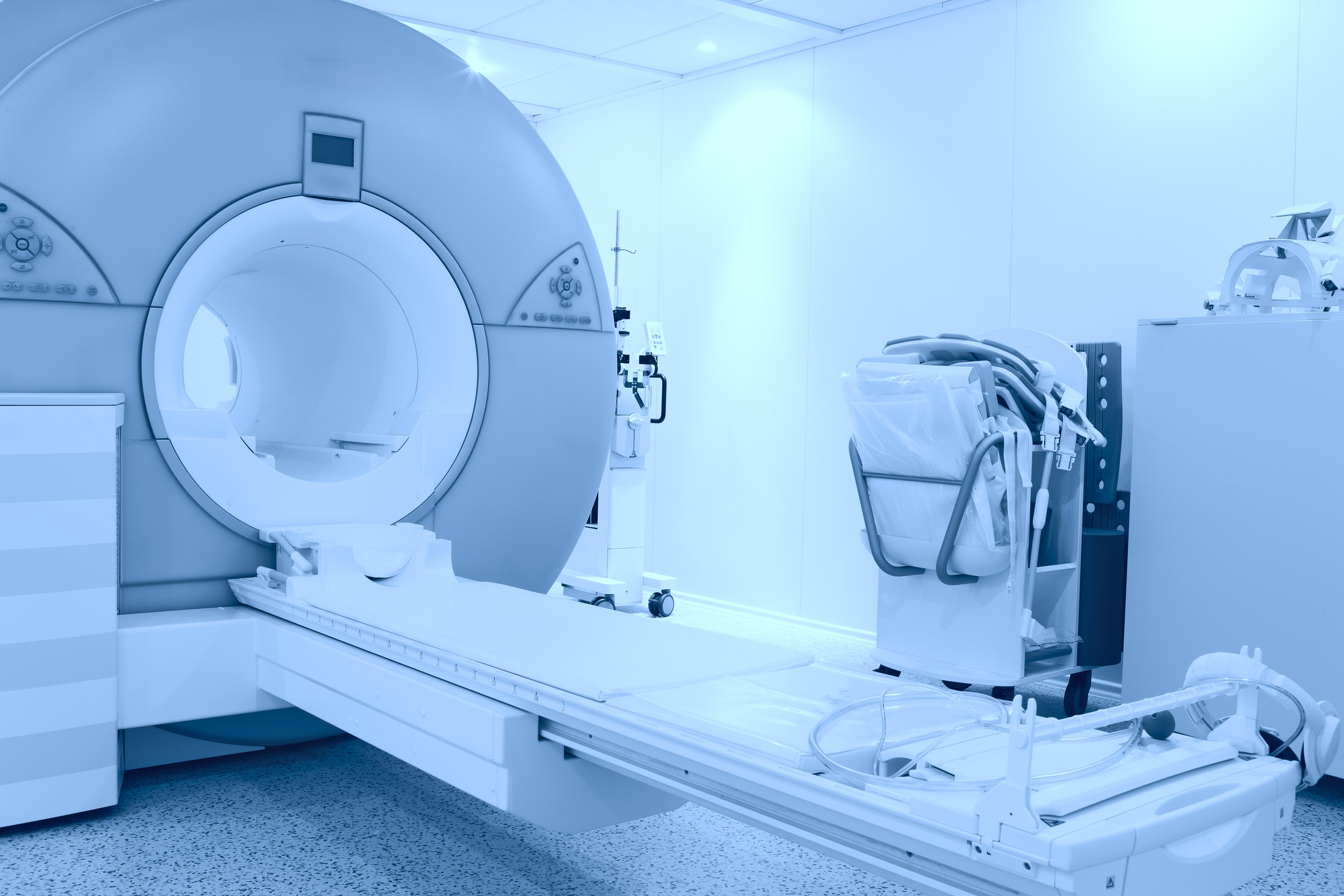
An MRI — magnetic resonance imaging — uses magnetic fields and radio waves to produce detailed images of soft tissue. Unlike X-rays or CT scans, it does not use radiation. That makes it the preferred tool for imaging the brain, spinal cord, joints, and organs when doctors need a clear picture of what is happening inside.
MRIs are ordered for a wide range of reasons. A doctor might order one after a knee injury to check for a torn ligament. After a stroke or seizure, an MRI of the brain can reveal the cause. For a patient with unexplained back pain, an MRI of the lumbar spine can show whether a disc is pressing on a nerve. They are also used to monitor tumors, diagnose multiple sclerosis, and evaluate inflammation in joints.
In many of these cases, a contrast agent is used to improve the quality of the images. Contrast material is injected through an IV before or during the scan. It makes certain structures, like blood vessels and tumors, appear brighter on the image. Doctors order contrast when they need to see how tissue is behaving, not just what it looks like. Whether or not contrast isused has a significant impact on the bill.
MRI bills are among the most error-prone in healthcare, and the problem is that catching them requires expertise most people do not have.
This guide explains the most common errors in image billing and how Reconcile can help you identify and flag these issues.
1. Where You Can Get an MRI — and Why It Matters
Where you get your MRI done affects everything about your bill. The same scan, on the same machine, ordered by the same doctor can cost dramatically different amounts depending on the setting. It also affects how the bill is structured, who sends it, and what errors are most likely to appear.
There are three main settings where patients receive MRIs.
Option 1: Hospital radiology department
This is an MRI performed inside a hospital, typically in the hospital’s own radiology or imaging department. This setting is most common when an MRI is ordered during or after a hospital stay, in the emergency department, or when a hospital-based specialist requests imaging.
Hospital radiology departments bill under the hospital’s taxID. That means the scan is subject to hospital billing rules, which include a facility fee on top of the scan charge. These facility fees are among the highest in the healthcare system and are often not disclosed to patients in advance.
Option 2: Hospital outpatient imaging center
This is an imaging center that is affiliated with a hospital but may be located off campus. It might be branded as a hospital imaging center or carry the hospital system’s name.
The key issue: even though the building may look like a regular imaging center, it still bills under the hospital’s tax ID. That means it charges facility fees similar to the hospital itself. Patients are often surprised to receive a bill that looks like a hospital bill for a scan they had at what appeared to be a stand-alone clinic.
Option 3: Independent imaging center
This is a free standing radiology practice that is not owned by or affiliated with a hospital. These centers focus exclusively on imaging. They typically do not charge a facility fee, which makes them significantly less expensive than hospital-affiliated settings for the same scan.
Independent imaging centers often cost 40 to 60 percent less than hospital outpatient settings for the same MRI. Many accept the same insurance plans. If your doctor gives you a referral and does not specify where to go, asking about independent options can make a meaningful difference to your out-of-pocket cost.
Here is how the three settings compare:
|
1. Hospital radiology department |
2. Hospital outpatient imaging center |
3. Independent imaging center |
| Setting |
Inside the hospital building |
Hospital-affiliated, often in a separate building |
Freestanding — not affiliated with a hospital |
| Facility fee |
Yes — typically the highest facility fee |
Yes — billed at the hospital outpatient rate |
No — no facility fee in most cases |
| Typical cost |
Highest |
High — often similar to inpatient rate |
Lowest — often 40–60% less than hospital rates |
| Billing complexity |
High — multiple departments may bill separately |
High — still billed under hospital tax ID |
Lower — usually one or two billing entities |
| When it makes sense |
Emergency or urgent need; no scheduling flexibility |
Ordered by a hospital-based physician; convenience |
Elective or scheduled scan; cost is a concern |
| Error risk |
Higher — more billing departments, more handoffs |
High — hospital billing rules apply |
Lower — simpler billing structure |
Costs vary significantly by region, insurer, and specific facility. Always check your insurer’s network and ask about estimated costs before scheduling.
Reconcile reviews your MRI bill line by line, flags potential errors, and tells you exactly what to do next — before you pay a cent.
Join the Free Beta →
Secure Upload. You review the findings before deciding whether to pursue escalation.
2. How MRI Billing Works
An MRI is usually not a single charge, so you’ll get multiple bills for a single scan.
Technical component
Billed by the facility
Covers the cost of the MRI machine, the imaging space, and the technologist who ran the scan. In a hospital setting this charge includes a facility fee. At an independent imaging center, it does not.
Professional component
Billed by the radiology group
The radiologist’s fee for reading the images and writing the report. Almost always billed separately from the facility — often by a different company — and may arrive weeks after the facility bill.
Contrast agent
Common error source
Gadolinium contrast is an injectable dye that improves image clarity. It adds a separate line item only when actually used. If you did not receive an injection, this charge should not appear on your bill — and if it does, it is one of the most frequently billed errors in MRI audits.
Facility fee
Hospital settings only
Hospital outpatient departments charge a facility fee on top of the scan. This fee is separate from the technical component and is often not disclosed before the appointment. Independent imaging centers generally do not charge one — which is why the same scan can cost 40–60% less at a freestanding center.
CPT code
Drives the price
Every MRI scan is assigned a five-digit CPT code that specifies the body part and whether contrast was used. The code determines the price — and a single wrong code can mean you’re billed for a procedure that was never performed. Without contrast, with contrast, and with and without contrast are three different codes at three different prices.
3. What Could Be Wrong With Your MRI Bill
These are the most common errors when MRI bills are audited. Most patients never see them. That is not because the errors are well hidden — it is because catching them requires comparing the itemized bill, the CPT codes, the radiology report, and the physician order all at once.
Contrast billed but not used
Most common
Contrast must be physically injected to be billed. If you did not receive an injection, there should be no contrast charge on your bill. This error is invisible from the summary bill — you need the itemized charges to see it.
Wrong CPT code
A scan without contrast has a lower CPT code and a lower price than one with contrast. If the prior authorization was for a contrast scan but the actual scan was done without it, the billing team may follow the authorization rather than what happened — resulting in a charge for a procedure you did not receive.
Duplicate reading fee
A common error is being billed for the reading fee twice — once from the facility and once from the radiology group. Two line items, same CPT code, different provider names. One of them should not be there. Note: a legitimate second interpretation by a different radiologist should appear as CPT 76140 (Imaging Overread), never as a repeat of the original code.
Bilateral billing for a unilateral scan
Some CPT codes have bilateral versions for scanning both sides of a joint. If your doctor ordered a scan of your left knee, the bill should reflect a unilateral code. A bilateral code means you are being charged for both knees. The physician’s clinical notes will specify which side should have been scanned — if the CPT code does not match, that is a documented error.
Upcoding
Billing fraud risk
Upcoding means billing for a more complex procedure than was performed. In MRI billing, this most often means billing for a scan with contrast when only a without-contrast scan was done. The price difference between those two categories can be several hundred dollars. The only way to detect it is to compare the CPT code on the itemized bill to what the radiology report describes.
Unbundled charges
Some MRI procedures include components that should be billed together as one code. Unbundling splits them into separate line items to increase the total. A contrast injection that is already included in the contrast MRI code should not also appear as a separate administration charge. CMS publishes bundling rules — but most patients have no way to look this up on their own.
4. How Insurance Affects Your MRI Bill
In-Network
Going to an in-network imaging center will help you keep cost at the negotiated rate, and your insurance will cover a higher percentage of the cost. However, it does not protect you from these coding issues. Here is how the math works out for a bill that was coded with contrast when the patient didn't receive contrast at all.
Billed amount
$3,200
Insurance negotiated rate
$2,100
Insurance coverage (80%)
−$1,680
Your total
$420
Billed amount
$2,800
Insurance negotiated rate
$1,750
Insurance coverage (80%)
−$1,400
Your total
$350
Difference in your out-of-pocket cost
$70 more if contrast is billed incorrectly
Assumes deductible already met, 80/20 coinsurance, and an insurer negotiated rate of ~65% of billed amount. If contrast was not used but is billed anyway, you pay $70 extra — and your insurer overpays by $280.
Out-of-Network
This one is important! Because radiologists are often contractors or work for a private group outside of the hospital, your scan might get covered by insurance at an out-of-network price. This means that they might only cover 20% of the cost instead of 80% in the above example. Because the radiology practice didn't get paid the amount they were expecting, there is a risk that they will send you a surprise "balance bill." The No Surprises Act limits this in many cases - but only if someone is paying attention. Check out our guide on balance bills to make sure this doesn't happen to you.
5. How Reconcile Helps
Spotting an MRI billing error is challenging - you need to know which codes are correct for the scan you had, which bundling rules apply, and what the right dispute process looks like for your specific plan type.
Most patients do not have this expertise. That is not a failure. It is a design feature of a billing system built for professionals, not patients.
Reconcile reviews your MRI bill, checks every CPT code, flags potential errors, and tells you exactly what to do next — before you pay a cent.
Join the Free Beta →
Secure Upload. You review the findings before deciding whether to pursue escalation.
Sources:
CMS: Physician Fee Schedule — Imaging CPT Codes
CMS: National Correct Coding Initiative (NCCI)
CMS: No Surprises Act Overview
Related: CT Scan Bill Incorrect? Common Imaging Billing Errors and How to Escalate
Related: Balance Billing - What Is It?
Have an MRI bill you’re not sure about? Reconcile is currently recruiting beta users. Sign up for free early access →
MRI bills are among the most error-prone in healthcare. Contrast charges, wrong CPT codes, duplicate reading fees — Reconcile reviews your bill before you pay.