

Surprised By Your Ambulance Bill? Here's What You Can Do

March 18, 2026
7 min
Multiple paid medical bills

Ambulance bills are one of the most common surprise medical bills in the US healthcare system. You didn’t choose the ambulance. You couldn’t. You were having an emergency.

And yet here you are, holding a bill for hundreds or thousands of dollars from a company you’ve never heard of.

This guide explains why that happens, what the law actually covers, and what your options are - including why the type of insurance you have matters.

1. Why Ambulance Bills Are So Often a Surprise

When you call 911, you have no say in which ambulance company shows up. The dispatcher sends whoever is available. That company may or may not be in your insurance network — and you have no way to check in the middle of an emergency.

This is the root of the problem. Ambulance providers — especially private ones — often operate outside insurance networks. When they do, they can bill at their full rate. Your insurance pays what they decide is “reasonable.” You get stuck with the rest. That gap is called balance billing. Here's an example of how it works:

Here's a simple example.

Ambulance company charges $3,500
Insurance reasonable & customary amount $1,200
Insurance pays (80% of $1,200) $960
Your 20% coinsurance $240

At this point, your cost-sharing is complete.

But then the ambulance company bills you for the difference:

$3,500 – $1,200 $2,300

← This extra $2,300 is balance billing.

Your coinsurance $240
Balance bill $2,300
Your total out-of-pocket $2,540

Whether you can fight it - and how - depends heavily on what type of ambulance you took and what type of insurance you have.

2. Ground vs. Air Ambulance — Very Different Rules

The federal No Surprises Act does not fully cover ground ambulance services. Air ambulance is a different story.

Ground ambulance Air ambulance
Typical cost $800 – $5,000+
Basic or advanced life support; per transport
$30,000 – $50,000+
Helicopter or fixed-wing; per transport
Federal protection against balance billing
No federal protection
Protected by federal law
You pay in-network rate only

If you took an air ambulance and yours was processed as out-of-network, you likely have strong grounds to dispute it. But if you took a ground ambulance, it might be tougher. Congress left ground ambulance out of the No Surprises Act. The Advisory Committee on Ground Ambulance and Patient Billing (GAPB) released recommendations on how best to protect consumers from surprise billing for emergency ground ambulance services, but right now, there are no federal laws capping what ground ambulance companies can charge you. However, many states have implemented state protections based on these recommendations, but whether they apply to you depends on the type of insurance you have.

3. Your Insurance Type Changes Everything

There are two main types of commercial health insurance in the US. They look the same from the outside but operate under completely different legal frameworks.

Fully insured Self-insured
Who typically has this plan Small employer employees, ACA marketplace, individual coverage Large employer employees
~65% of workers with employer coverage
Who pays your claims Your insurance carrier
e.g. Aetna, BCBS, Cigna
Your employer directly
Carrier is administrator only
Governing law State insurance law
Regulated by your state's insurance department
Federal ERISA
State laws generally blocked from applying
State balance billing laws apply? Yes
If your state has them
No
ERISA preempts most state protections

Not sure which type you have? Check out our guide to Insurance Types to explain the difference and how to find out.

If You Have a Fully Insured Plan (State-Regulated)

State balance billing laws apply to you. About 20 states have meaningful ground ambulance protections, with 4 more offering partial coverage.The map below shows where those protections exist.
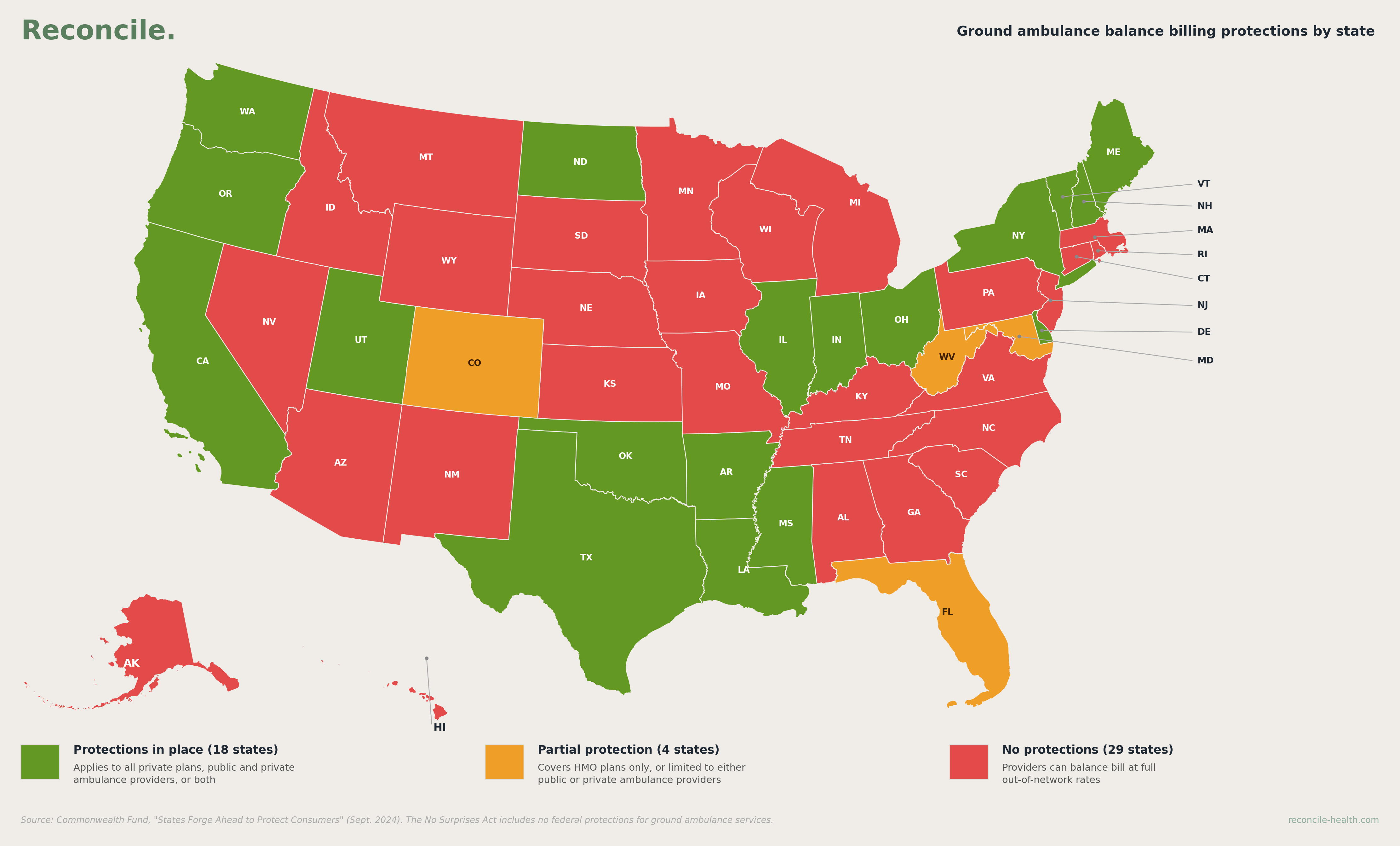
Ground ambulance balance billing protections by state

Click to expand

× Ground ambulance balance billing protections by state

If your state has protections and you were balance-billed, you have a legal basis to dispute the charge.

If You Have A Self-Insured Employer Plan — state laws don’t apply

Here’s the hard truth: if your insurance comes from a large employer — most companies with more than 200 employees self-insure — your state’s ground ambulance laws almost certainly don’t apply to your plan. ERISA,the federal law that governs these plans, generally blocks states from regulating them.

That means even if you live in California or New York — states with strong ambulance protections — those protections may not cover you.

The second map shows the real-world picture for self-insured plan members. It shows the actual prevalence of out-of-network ambulance billing.
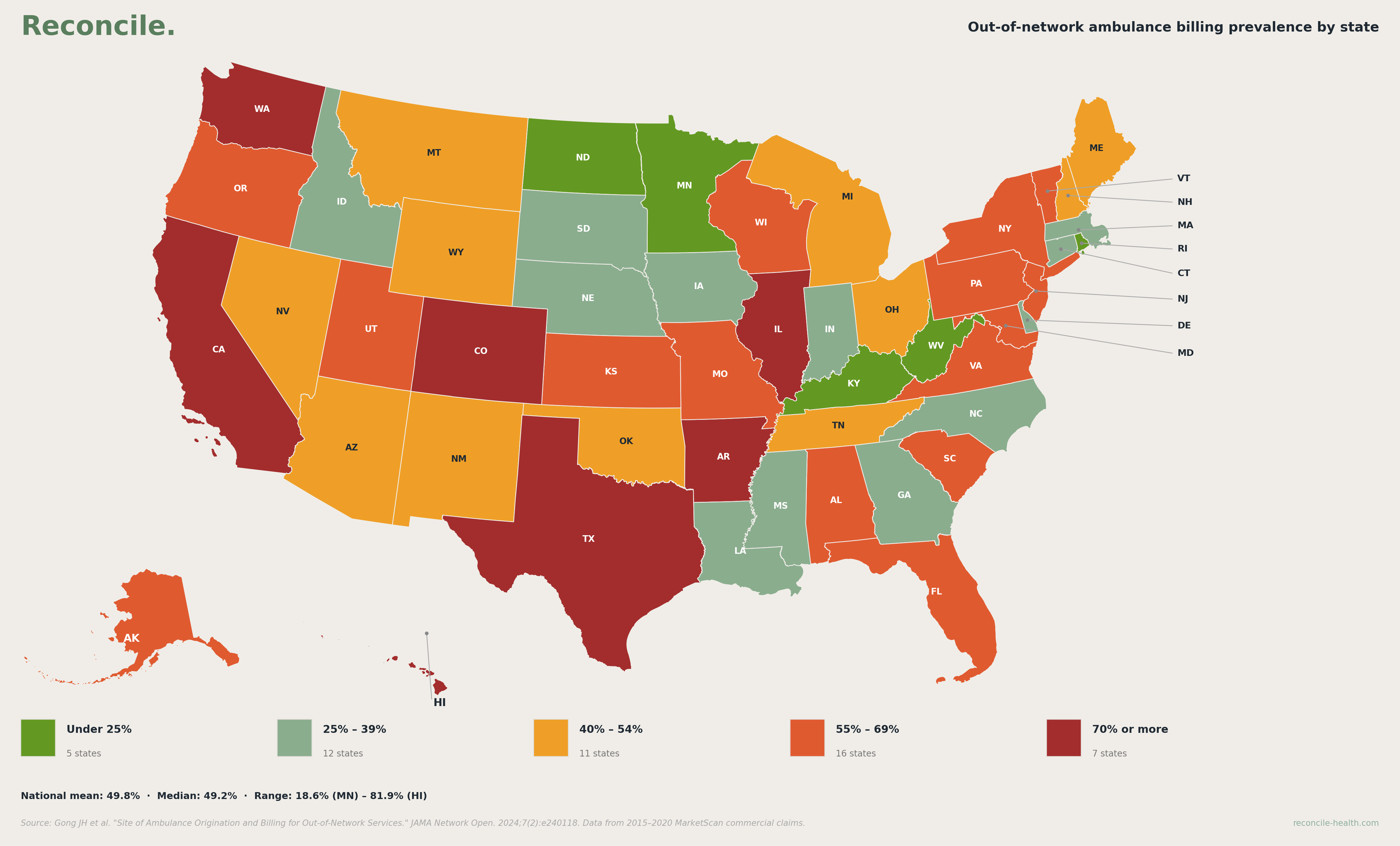
Out-of-Network Ambulance Billing Prevalence By State

Click to expand

× Out-of-Network Ambulance Billing Prevalence By State

The national average is close to 50%. In states like Colorado, Illinois, Texas, Washington, and California, more than 70% of ground ambulance rides result in an out-of-network bill. Even in “protected” states, the real-world out-of-network rate is high — because those state protections don’t reach self-insured plans.

4. What to do before you pay - and how we can help

Regardless of your type of insurance, always request the following two things as the starting point:

  1. Explanation of Benefits (EOB) from your insurance company
  2. Itemized bill from the ambulance company

From these two documents, Reconcile can conduct a proper review of the bill. Here are our steps:

Check the bill for errors

Reconcile leverages its expertise in medical coding & billing to flag potential errors. Some common ambulance billing errors include:

  • Level of Service - Advanced Life Support (ALS) is significantly more expensive than Basic Life Support (BLS). If your situation did not require advanced care but was coded as ALS, you are likely being overcharged.
  • Wrong Mileage - Distance between pickup and drop-off is billed by the mile, and overstatements are common.
  • Charges for supplies not used - Just because the equipment is in the ambulance, doesn't mean you should be charged for it. You should only be charged for the items used.
  • Duplicate charges for the same item
Verifying how your insurer processed the claim

Your Explanation of Benefits (EOB) shows what your insurer paid and what they say you owe — but it doesn’t tell you whether the claim was processed correctly. Reconcile will check:

  • Was it coded as emergency transport?
  • Was the allowed amount based on a fair rate for your area?
  • Was any state balance billing protection applied?
  • Was the correct network determination made?
Negotiate the balance

If the bill is valid but higher than it should be, negotiation is the next step. Ambulance billing companies have internal programs for financial hardship, reduced settlements, and payment plans — none of which they advertise.

This is exactly what Reconcile was built to handle. We review your bill line by line, check your EOB against your plan terms, flag every error and overcharge, and then take the dispute forward on your behalf — so you don’t have to spend your evenings on hold with a billing department.

We're here to take this off your plate.

Reconcile reviews your bill, flags potential errors, and tells you exactly what to do next — before you pay a cent.

Why This Keeps Happening

Ambulance billing is one of the last areas of US healthcare where patients have almost no control and almost no transparency. You cannot shop for a provider. You cannot check networks. You cannot consent to the rate before you get in the vehicle.

The insurance type gap makes it worse. State legislatures pass balance billing laws thinking they are protecting their residents. But the majority of working age adults between the ages of 26- 64 are covered by their employers and these laws don't reach them at all.

The GAPB has recommended expanding protections to cover ground ambulance. But until that passes, the ERISA gap remains — and patients need expert help to navigate it.

For more on how out-of-network billing works across other surprise bill types — including anesthesia — see our guide: Is My Anesthesia Bill Correct?

Sources:
Map 1:
Commonwealth Fund, "Expanding the No Surprises Act to Protect Consumers from Surprise Ambulance Bills: Map of State Laws." Updated on Feb 5, 2026.
Map 2:
Gong, JH et al.JAMA Network Open. 2024

How Reconcile Can Help

Reconcile takes all of this complexity off your plate. We review your bill, check your insurance adjustments, and flag anything that doesn’t look right – then tell you exactly what to do next, in plain language.

Join the Free Beta →
Surprise Ambulance Bill? Your Rights and Options
March 24, 2026
Ambulance Bills Can Reach $5K - and most patients don't know they can fight them. Learn your rights and what to do before you pay.
surprise-ambulance-bill-your-rights-and-options
Share this post